Monday, July 20, 2020

Tetrad Of Dulcet Music:: Anand Bakshi :: Lata Mangeshkar :: Laxmikant-Pyarelal

Tetrad Of Dulcet Music:: 
Anand Bakshi :: Lata Mangeshkar :: 
Laxmikant-Pyarelal 

Tribute to popular songwriter Anand Bakshi on his 90th Birth anniversary, 21 July. 


Laxmikant-Pyarelal with Anand Bakshi, 1680 songs from 302 films, a massive contribution to Hindi Film Music. 
                                        
Lata Mangeshkar, Sound Engineer Mr. Minoo Kartik, Laxmikant, Anand Bakshi & Pyarelal


When we talk of Lata Mangeshkar and Laxmikant-Pyarelal songs, 712 in numbers of sheer variety.  What mind-boggling range did we get in those numbers. 


गायिका लता मंगेशकर, गीतकार आनंद बक्षी और संगीतकार लक्ष्मीकांत-प्यारेलाल


In this blog highlighting the Tetrad Of Dulcet Music, Anand Bakshi, Laxmikant-Pyarelal and Lata Mangeshkar. Lata Mangeshkar have rendered as many as  240 solo songs, involving Laxmikant-Pyarelal & Anand Bakshi.  The Tetrad's First Song was Julmi Hamare Sanwariya from the Film, Kishore Kumar - Kum Kum Starer "Mr. X In Bombay", 1964
Laxmikant, Anand Bakshi, Lata Mangeshkar, Pyarelal. 


240 solo songs of different types and sheer variety, rendered by Lata Mangeshkar in the quadripartite. Considering 15 songs for the review. There are many films, listed below from this Tetrad in which Lata Mangeshkar has sung  five or more songs.


  • Lootera 1966 ( an outstanding Album with all SIX solo with variety from Lata  )
  • Sharafat 1970
  • Mera Gaon Mera Desh 1972..(Folkish Album, all time hit )
  • Raja Jani 1972
  • Bobby 1973 (All time hit songs)
  • Satyam Shivam Sundaram 1978 (Eternal Classic)
  • Ek Duje Ke Liye 1981  


Anand Bakshi and Laxmikant-Pyarelal were known to compose a ‘Situational Songs’. Two such songs from “Mera Gaon Mera Desh” are revied. 


The orchestra arrangements in “preludes” and “interludes” used to be the assets of the songs composed by Laxmikant-Pyarelal. It would be more proper to listen to the songs  after reading the write up, explaining peculiarities, for each of the songs,  you will enjoy it more.


Julmi Hamare Sanwariya    “Mr In Bombay” 1964


An extremely melodious song. Prelude of 38 seconds with VIOLINS, GUITAR, FLUTE and beautiful aalap by Lata ji. Awesome take off जुल्मी हमारे सांवरिया हो राम।  Ear-Pleasing DHOLAK rhythm. First ‘interlude’ is orchestrated with NADASWARAM/SHEHNAI. Second ‘interlude’ is orchestrated with NAGIN  BIN, VIOLINS. Third ‘interlude’ again NAGIN BIN and  VIOLINS. Actress Kum Kum danced wonderfully through the song. 


O Dilwalo Saaz-E-Dil      “Lootera” 1965


Actress Bela Bose entertains sea dacoits with a fabulous song and a dance onboard. GEM of composition, beautifully sung by Lata Mangeshkar. Based on Arabian Folk Tune…’Prelude” of 37 seconds with VIOLINS, BRASS INSTRUMENTS,  ACOUSTIC GUITAR and western style ‘Aalaps’ from Lata j, mesmerizes the listers. The other speciality of the song is Lata’s Voice is surrounded by the MALE CHORUS and the FLUTE, both in ‘antara’ as well as in ‘mukhada’….The orchestra arrangements is just simply the best, specially use of FLUTE, solo VIOLIN,  ACOUSTIC GUITAR, CLAPPING  and the BONGO DRUM in rhythm. Dancer Bela Bose has danced this old fashion cabaret perfectly on tune masterly filmed on Balener Ship.

Suno Sajna Papeehe Ne  “Aaye Din Bahar Ke” 1966

My most liked Lata-LP song.....The chirping sound of birds and a mesmerizing aalap at the beginning sets the tone of the song........fabulous Flute (played by Pt. Hariprasad Chaurasiya), Santoor (played by Shivkumar Sharma)  and Sitar pieces in the interludes.


Nind Kabhi Rehati Thi Aankhon Mein  “Aasra” 1966


The song with full of “pauses”
This is an extremely melodious romantic song starts with the ‘humming’ by Lataji for first 10 seconds, we get first beautiful “pause” at 0.10 - 0.13, second, after rendering ‘Neend Kabhi Rehti Thi Aankhon Mein’ at 0.20 - 0.23, third after rendering word ’sanwariya’ at 0.33 - 0.36, this pause gives you to listen to the beautiful ‘RHYTHM’ created for this lovely song. You will listen to all these “pauses” regularly till the end. Don’t forget to listen to the ‘pause’ at 3.58 to 4.01 to highlight the FLUTE.
The entire song, mainly “interludes'', are woven around the glimpses of FLUTE (by Pt. Hariprasad Chaurasiya) and SANTOOR (by Pt. Shivkumar Sharma) and SYMPHONY style VIOLINS (at the surround sound of Lataji, in ‘mukhda’ and ‘antara’). The rhythm of DHOLAK and TABLA is worth listening to as it is of different flavor. On the top of everything…the chemistry of Lataji & LP worked miracles. Filmed on Mala Sinha. 


Jab Jab Bahar Aayee  “Taqdeer”  1967
Entire song is woven around the glimpses of PIANO, VIOLINS as well as CHORUS. 


Sanz Savere Adharon Pe Mere   “Madhavi”  1969


A beautiful, melodious, sweet 'MEERA' "BHAJAN" from the film "Madhavi" 1969. A classic song from the unique Tetrad  of Lata Mangeshkar,  Laxmikant-Pyarelal and Anand Bakshi.


Bindiya Chamake Gi  “Do Raaste”  1969


This “Punjabi” folkish style,  DHOLAK rhythm, sweet and melodious  song, with euphonic DHOLAK ‘rhythm’  is completely decorated with the glimpses of SANTOOR and FLUTE. Lataji’s rendering of the word ‘chamake gi’ (चमके गी) is admirable. The song rock the nation and was a top hit, number 1 song, in Binaca Geetmala Finals of  the year 1970.  The song made Mumtaz a ‘star’, overnight. 


Mar Diya Jaaye Ke Chhod Diya Jaay  “Mera Gaon Mera Desh” 1971


Raj Khosla explained to Anand Bakshi a situation where the hero is tied to a pillar and the girl wants to rescue him. Anand Bakshi was at once reminded of the dialogue between Alexander the Great and King Porus where the former asked the latter "Tumhare saath kya sulook kiya jaye?" And the song Maar diya jaye, ke chhod diya jaye... was born. Laxmikant-Pyarelal have mind-blowingly orchestrated this fabulous song, with 43 seconds of “prelude”, “interludes” and mesmerizing DHOLAK rhythm. The song is beautifully filmed on Laxmi Chhaya. 


Apani Prem Kahaniyan   “Mera Gaon Mera Desh” 1971


One of the best ""situational"" numbers you would get to see. It’s gestural song situation. Raj Khosla have done the best to film this songThe police get no help either, when they arrive in village "mela"/Fair.. . Nobody is willing to recognizing "Dacoit" Jabbar Singh (VINOD KHANNA) and his gang. Ajit ( DHARMENDRA ) seeks the help of dancing girl Munnibai (LAXMI CHHAYA), to identify Jabbar Singh in a village "mela". Through the dancing on song, Munnibai is giving many hints of Jabbar Singh's physic, dress and the location where he is standing…This popular dancing song has a perfect set of village fare. Costumes, Cinematography is excellent.  ANAND BAXI, has worded this song according to the situation demand.  LAXMIKANT-PYARELAL have decorated this song with mellifluent orchestra arrangements. "Prelude" and all the "Interludes" are justifying the village "mela"/fair music. The RHYTHM of the song is mesmerizing. LATA MANGESHKAR simply outstanding…The song is beautifully filmed on Laxmi Chhaya. 


Bandhan Toote Na  “Mom Ki Gudiya”  1972


This song can be considered as a Very Very Special from Lata Mangeshkar / Laxmikant-Pyarelal/Anand Bakshi. Rendered on high pitch, without losing it’s Melody part. It is based on Indian Classical raaga. SAROD, RUBAB as well as VIOLINS are sweetly instrumented in the song.  Based on Indian Classical ‘Raag’. Filmed on Tanuja 


Dard - E - Dil Badhata  Jaye    “Buniyad” 1972


CABARET song with MELODY: Laxmikant-Pyarelal’s work is characterized by a notable openness to a wide variety of musical styles and instruments. Classical ragas mix with JAZZ horns, WAH-WAH GUITAR, FLUTE, funk and disco RHYTHMS, and the insistent beat of the DHOLAK.  How brilliantly the western instruments like BAMBOO FLUTE and GUITAR are synchronized with Lata’s sweet voice, in this mellifluous orchestra arrangements . All the three interludes have different tunes.
During the sixties & seventies Lata and Laxmikant-Pyarelal combination have delivered some of the most melodious songs to the Indian Film Industry and this is one them.
This is one of the sweetest cabaret song sung by Lata for LP. This song is written by none other than Anand Baxi. Filmed on actress Bindu. 


Bhor Bhaye Panghat Pe    “Satyam Shivam Sundaram”  1978


67 seconds of resonant ‘preludes’ starts with euphonic ‘aalaps’ by Lataji, TWEETING BIRDS sound, protruding as well as integrating surround sound effect of symphony style VIOLINS, GHUNGROO BELLS and finally hypnotising DHOLAK / TABLA rhythm which is the asset of this songs. GHUNGROO BELLS are beautifully synchronised  with the DHOLAK / TABLA rhythm, throughout the song.  Interludes are well orchestrated with GUITAR, SITAR, FLUTE, SYMPHONY style VIOLINS and CELLOS. Filmed on Zeenat Aman. 


Sheesha Ho Ya Dil Ho      “Aasha”  1979
20 seconds of ‘prelude’ is full of Latajis honeyed AALAPS. Brilliant take off...शीशा हो या दिल हो ...She gives 3 seconds of singing ‘pause’  for symphonious DHOLAK rhythm. First and Second interludes are orchestrated with an ACCORDION. Third interlude has a solo display of VIOLIN. Another beauty of this song is ‘singing’ and ‘rhythmic’ pauses. This beautiful song is filmed on Reena Roy singing this song on stage. 


Tere Mere Beech Main    “Ek Duje Ke Liye”  1981


Composed in Hindustani Classical Raag “SHIVRANJANI”. 16 seconds of ‘prelude’ orchestrated with glimpses of GUITAR, Symphony style CELLOs, and VIOLINS and awesome aalaps by Lataji. Excellent “DHOLAK” rhythm. SANTOOR, FLUTE, VIOLINS and SHEHANAI are mellifluously decorated in the orchestra. Filmed on Rati Agnihotri 


Nindiya Se Aayee Bahar    Hero 1983
55 seconds of “Prelude” is in SYMPHONY style with excellent use of CELOs intermixed with the rendering of Lataji and BIRDs TWEETING sound. SHEHNAI is nicely played in the first “ interlude”. Second “interlude” is full of FLUTE. Once again an excellent DHOLAK rhythm. Lovely composition. glimpses of FLUTE (by Pt. Hariprasad Chaurasiya). Filmed on Meenakshi Sheshadri. 


Jind Le Gaya Wo Dil Ka Jaani  “Aap Ke Saath” 1986.


Good song with typical LP style melody filmed on Smita Patil. 


Ajay Poundarik
Atlanta (Georgia)
USA. 
Friday, July 17, 2020

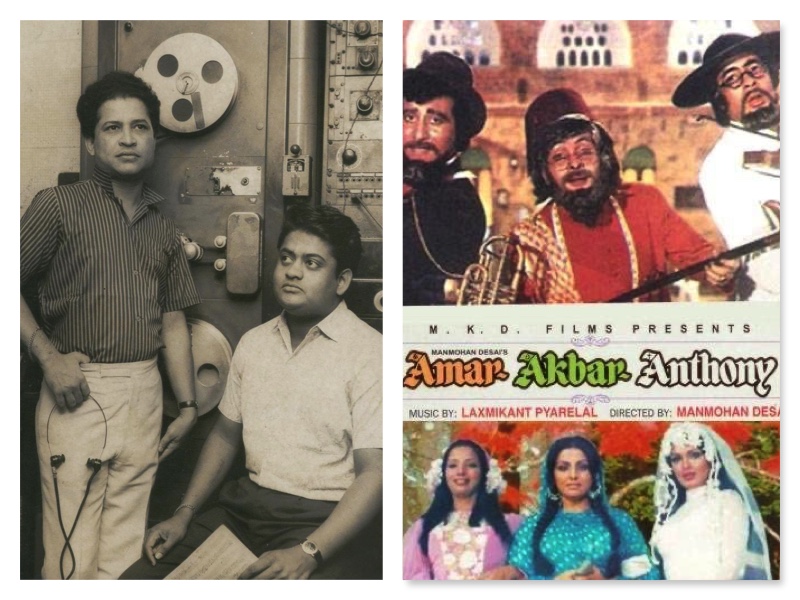
Manmohan Desai :: Laxmikant-Pyarelal :: AMAR AKBAR ANTHONY, Musical Blockbuster.

Manmohan Desai :: Laxmikant-Pyarelal                                                                                       AMAR AKBAR ANTHONY, Musical Blockbuster.


In the sixties Manmohan Desai has directed many hit films under the different banners. He was considered to be the successful director of the sixties / seventies / eighties. 


Manmohan Desai was known for making family-centered, action, song and dance films which catered to the tastes of the Indian masses and through which he achieved great success.
Manmohan Desai’s common plot was lost and found formula with a happy ending. 


Prior to ‘Amar Akbar Anthony’ Manmohan Desai directed the followings of the films, with various music directors, mentioned in brackets.


1957 Janam Janam  Ke Phere   (S N Tripathi)
1960 Chhaliya  (Kalyanji-Anandji)
1963 Bluffmaster (Kalyanji-Anandji)
1966 Badtameez (Shankar-Jaikishan)
1968 Kismat (O P Nayyar)
1970 Sachcha Jhutha (Kalyanji-Anandji)
1972 Rampur Ka Laxman ( R D Burman)
1972 Bhai Ho To Aisa (Sonik-Omi)
1973 Aa Gale Lag Ja (R D Burman)
1974 Roti (Laxmikant-Pyarelal). 


When Manmohan Desai started his production house named MKD Films, he wanted to have top class, in-form artists for his very first film as a Producer and Director. It was a star-studded film with Amitabh Bachchan, Rishi Kapoor, Vinod Khanna, Neetu Singh, Parveen Babi, Shabana Aazmi in lead roles. Pran and Jeevan in supporting roles.


Music directors duo Laxmikant-Pyarelal in supreme form, then and considered for the music. The association of Manmohan Desai with Laxmikant-Pyarelal started from “Roti.


Music was an asset for Amar Akbar Anthony. The songs became popular. Most of the songs are sung by Mohammad Rafi except one (My Name Is Anthony Gonsalves), by Kishore Kumar.  There are two songs that remain special for Amar Akbar Anthony. 


Amitabh Bachchan’s character name was Anthony Fernandies initially. Laxmikant-Pyarelal requested Manmohan Desai to change it to Anthony Gonsalves. Pyarelal wanted to pay tribute to Mr. Anthony Gonsalves, the violin guru of Pyarelal. Manmohan Desai agreed. The song was recorded. The song "My Name Is Anthony Gonsalves" is Pyarelal's tribute to his violin teacher. 

Pyarelal, Subhash Desai, Laxmikant, Mohammad Rafi, Mukesh,
Lata Mangeshkar, Kishore Kumar and Manmohan Desai


The song  .Hum Ko Tumse Ho Gaya Hai Pyar Kya Kare
A  HISTORIC  MOMENT  OF  HINDI  FILM  MUSIC  WHEN  FOUR  SENSATIONAL  SINGERS..Lata Mangeshkar, Mohammad Rafi, Kishore Kumar and Mukesh at a one stage for the FIRST and LAST time for the recording of the song from Manmohan Desai's "Amar Akbar Anthony" .  
Pyarelal, Kishore Kumar, Mohammad Rafi, Lata Mangeshkar, Mukesh and  Laxmikant
Binaca Geetmala:-


Almost all the songs of “Amar Akbar Anthony '' appeared in the weekly countdown show.           
In the 1977 finals of Binaca Geetmala
41 Position :- Tayyab Ali Pyar Ka Dushman
11 Position :-  Anhonee Ko Honee Kar De
02 Position :- Parda Hai Parda 


Filmfare Awards for ”Amar Akbar Anthony”


Best Film “Amar Akbar Anthony”
Best Actor Amitabh Bachchan
Best Music Laxmikant-Pyarelal
Best Editing. 


Amar Akbar Anthony was Musical Hit. The songs of AAA are still popular 


All the songs of Amar Akbar Anthony are written by Anand Bakshi. 


1   PARDA HAI PARDA …..Mohmmad Rafi
 Qawwali style composition, brilliantly rendered. Rafi Saab sang this song at the age of 53 years old for 25 years old Rishi Kapoor in this film. The divine talent of Rafi Saab. The sweetness in the voice is beyond words. What a variation in the pitch !!! Only Rafi Saab can do this. Awesomely orchestrated by using MANDOLIN, SHEHNAI / NADASWARAM synchronised with amazing DHOLAK / TABLA rhythm. Rishi Kapoor rocks.  

2  SHIRDIWALE SAI BABA…..Mohmmad Rafi
When it comes to devotional songs,, Rafi Saab is the best. It also has a Qawwali rhythm. Clapping  (ताली ) nicely intermixed with the DHOLAK rhythm. Interludes are orchestrated with MANDOLIN, SHEHNAI / NADASWARAM . Rishi Kapoor performs best. 


3  TAYYAB ALI PYAR KA …..Mohmmad Rafi and Mukari. 
Once again a Qawwali rhythm. Rishi Kapoor dominates the song.


4  MY NAME IS ANTHONY…..Kishore Kumar and  Amitabh Bachchan. 
This song will always be remembered for the tribute to the ‘Violin” “GURU” of Mr. PYARELAL Mr Anthony Gonsalvis. The song has western beats. All the BRASS instruments are brilliantly used, synchronizing with BONGO drum rhythm. Amitabh Bachchan’s rendering in the “interludes” is just brilliant. As an actor Amitabh Bachchan is the best in this song. 


5  HUMKO TUMSE HO GAYA...Lata Mangeshkar, M. Rafi, Kishore Kumar, Mukesh
All the three "mukhada" with different tunes, all the three "interludes" have different musical notes.


6  ANHONEE KO HONEE KAR DE….Shailendra Sing, Kishore Kumar, Mahendra K. 
Very popular peppy song. 


Amar Akbar Anthony is one of the biggest musical blockbusters of all time. The partnership of Manmohan Desai with Laxmikant-Pyarelal gets a firm grip. Later this combo delivered a few more musical hits, five of them with Amitabh Bachchan.


Dharam Veer 1977
Parvarish 1977
Chacha Bhatija 1977
Suhag  1979
Naseeb  1981
Desh Premi 1982
Coolie  1983
Deewana Mastana 1998. 


Ajay Poundarik.
Atlanta (Georgia)
USA


Wednesday, July 15, 2020

Laxmikant-Pyarelal at their ‘melodious’ best. UPHAAR 1971

 Laxmikant-Pyarelal at their ‘melodious’ best. UPHAAR 1971

Laxmikant-Pyarelal were in supreme form in early seventies and now most of the big/small producers & directors wanted to have music for their respective films, to be scored by none other than Laxmikant-Pyarelal.
It is also to be noted that looking back at the tremendous success of the earlier non-starcast, musical hit films, many of the BIG names also started making non-starcast films with the music by number one music director, Laxmikant-Pyarelal, then. “UPHAAR” is such a musical hit film. 
“UPHAAR”, released in December, 1971, was produced by Rajshri Productions (Tarachand Badjatya), now BIG name, directed by Sudhendu Roy. It was based on a story by Ravindranath Taigore. 

Uphaar is one wonderful film relating the story of a young village girl who is still a little kid by heart. It has many unknown actors and actresses. Jaya Bhaduri was not a star then, it was her second film after “Guddi” (October, 1971). Swaroop Dutt was a new /unknown hero. Laxmikant-Pyarelal music and the songs flow with the theme of the story of the film. 
In the early seventies, during the peak wave of Kishore Kumar, Laxmikant-Pyarelal gave some of the best songs for Mohammad Rafi to sing. “UPHAAR” song ( main ek raja houn) is one of them. 
One can imagine the output of Laxmikant-Pyarelal with Mohammad Rafi when out of 379 songs sung by Mohmmad Rafi under the LP, 254 songs were recorded during the peak wave of Kishore Kumar (post "Aradhana") that too without affecting the 'giant' popularity of Kishore Kumar. 
It has extremely sweet and melodious FOUR songs. Special mention has to be made for the melodious background music of Laxmikant-Pyarelal in the film. The film was a musical HIT. 
Anand Bakshi has written all the songs of ‘UPHAAR’.

The orchestra arrangements in “preludes” and “interludes” used to be the assets of the songs composed by Laxmikant-Pyarelal. It would be more proper to listen to the songs  after reading the write up, explaining peculiarities, for each of the songs,  you will enjoy it more.

1) MAIN EK RAJA HOUN…Mohammad Rafi.

“Prelude” of 27 seconds comprises of VINA and SANTOOR and Mohammad Rafi’s beautiful take off (main ek raja houn) is just brilliant. Extremely Soft and Melodious ROMANTIC song composed in the “raag" ' BAIRAGI'. Use of the BONGO drum in “Toe Stepping Rhythm” intermixed with SANTOOR is ear-pleasing. Use of FLUTE , ACOUSTIC GUITAR, SANTOOR and SITAR and other string instruments are mellifluously executed in the song. In early seventies Mohammad Rafi was almost forgotten but it was only Laxmikant-Pyarelal gave some of the finest songs to Rafi. This is one of them. It was a “Binaca Geetmala Hit song”.


2) HATHON MEIN MEHNDI..Lata Mangeshkar.

The perfect wedding song, sweet and melodious, as well. Excellent “prelude”, starting from 0.41 to 1.14 This song is a ‘folk’ showing traditional Rajasthani “ KATHPUTLI”. HAND DRUMS and the “BOLI” / “SHRUTTI” (This is a musical instrument made of two thin and small bamboo strips which have a reed in between and produces a sharp sound by blowing air in and out on it) are beautifully decorated in the orchestra to give the traditional “FOLK” touch. Lata Mangeshkar has brilliantly synchronized her voice with Laxmikant-Pyarelal's orchestra arrangements.


3) MAAZI NAIYYA DHUNDHE KINARA …Mukesh

Another extremely melodious composition. Excellent “prelude”, mesmerizing “Interludes” comprises SITAR, VIOLA, VINA, FLUTE with wonderful “DHOLAK” rhythm and soulful singing. Singer Mukesh is at his melodious best. Very Good Song for Aspiration.


4) SUNI RE NAGARIYA SUNI RE SAJARIYA …Lata Mangeshkar. 

All the traditional Indian Classical Instruments, SITAR, VINA, SHEHANI, SARANGI, SAROD,etc are wonderfully used in this very sweet song. “DHOLAK” rhythm is awesome. Lata Mangeshkar always sounds extremely melodious under the Laxmikant-Pyarelal. This song proves that.

“UPHAAR” songs are extremely melodious, different types of composition and are still refreshing. A must Album for all Laxmikant-Pyarelal music lovers. 


Ajay Poundarik

३ सितम्बर  जनमदीन की शुभकामना #प्यारेलाल (#लक्ष्मीकांतप्यारेलाल) #LaxmikantPyarelal

 जनमदीन की शुभकामना   #प्यारेलाल (लक्ष्मीकांत-प्यारेलाल) #LaxmikantPyarelal    ३ सितम्बर लिविंग लीजेंड, हिंदी फिल्म संगीत  सबसे लोकप्रिय औ...